Friday, June 18, 2010

Flynn Family Reunion

Every summer we have a Flynn picnic at a local Forest Preserve shelterhouse. Everyone in the family is invited, but usually just those of us that still live in the area show up, eat some good food, play a few games and catch up with each others' lives. Every three years, however, is the BIG Flynn reunion. The one where everyone makes a little extra effort to come, even those that live across country.

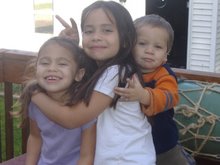
This year was one of those years. The year for the geographically-extended family to come back to their roots and hang out near Irish Grove for awhile. The Flynn's have been in America for 6 generations and counting.  So there's lots of us by now.  Here's a small sampling of the crowd.  Can you still see a family resemblance?


Lots of cousins. 

Lots of Flynn's. 

Lots of love.

Thursday, June 17, 2010

Change--For Better and For Worse

I tend to ignore the conventional side of the farm. On this blog, that is. Truth is, I never wanted to be a conventional farmer. Row crops--corn and soybeans--with their genetic potential and maturity dates, their herbicides and pesticides, their crop insurance and FSA payments, their demand for large and expensive equipment, their moisture levels and storage charges--they're not what's got me whistling while I work on the farm, if you know what I mean.

But I want to be very honest with you all about my relationship with conventional row crops, so that you can be honest with yourselves about yours: the row crops on this farm have been financially propping up the organic acres for 4 long years now and they should receive the credit they deserve. And I think I'm safe in assuming that row crops have probably been financially propping up your ability to buy organic and local as well. In other words, we all need to be better about leaving the judgment behind while we strive to do better.

We made some changes this year regarding our row crops. Changes for better and for worse. You see, last year was one of those years that just about breaks a farm. I have already whined and complained enough about the quadruple whammy of last year's high input costs + lower crop revenue + wet harvest weather + a gazillion dollars worth of drying charges, but the result isn't pretty. The result is a farm walking a fine line between financial solvency and financial ruin. I think the most shocking part of the whole situation is that it only took one year to get to this point! One year! (Ok, so the quadruple whammy also coincided with some needed equipment purchases and the removal of one field from the sugar daddy row crops to that cute new hussy on the block named Organic Transition.)

Anyways, since I've run the farm I had refused to plant GMO anything. Straight conventional all the way, baby. I was filled with self-righteousness and an unending optimism that only new farmers have: if it worked before it'll work again.

Except it didn't work. The weeds on our farm are typical of the weeds on most farms that have been conventionally managed for over 50 years--resistant to many conventional herbicides. Yes, we sprayed. And yes, the weeds thumbed their noses at us and laughed all the way to maturity. (Remember those posts that have Marcel and I wielding machetes and felling giant ragweed?) After 3 years of ineffective herbicide applications, low yields and falling farm revenue, I had to be honest with myself that my system wasn't working.

So we changed our rotation to favor corn in order to level out the farm revenue we could expect year after year. We have 3 fields in row crops, which had meant if this year 2 of them would be planted to corn and 1 to soybeans, the following year 2 of them would be soybeans and 1 corn. Corn makes more money than soybeans--depending on the year it can be substantially more. So the way it was, we would have a decent farm income one year and a bad one the next. On and on and on.

We switched our rotation so that every year we'd have 2 fields in corn, meaning field #1 in 1st year corn (corn after soybeans), field #2 in 2nd year corn (corn after corn), and field #3 in soybeans (soybeans after corn). Revenue should level out so that we know, more or less, how much money is coming in. Better income control means better planning means more stability. Stability means less stress and less risk of financial ruin. Whew.

The bad news: corn on corn requires more nitrogen. (We used the same amount of anhydrous ammonia as last year, but also put on a pelletized, slow release product that will give the corn an extra boost as it grows.)

The good news: I planted non-GMO corn again, because the herbicides you can use on straight conventional corn are still effective and because we feed corn to our chickens and grain-fed beef. Our beef, egg and chicken customers don't want GMO feed, so no GMO corn.

Soybeans are another story. Our soybean fields have been a horrible mess and our yields have been falling. There are fewer conventional herbicides that can be used on soybeans and our weeds are resistant to them. It has gotten to a point where they control large percentages of the field, crowding out the crops and competing for nutrients.

The bad news: we switched back to GMO soybeans. Round-up Ready, to be exact.

The good news: our weeds will be better controlled, our yields should increase substantially, and we'll make a little more money off of the field. (More money = more money for that hussy O.T.)

On the fertilizing front, we made a definite change for the positive. A company based in Wisconsin, Midwestern Bio-Ag, sells fertilizers, soil amendments and forage seeds and work with both conventional and organic farmers. They promote balanced, mineralized soils for improved crops. Blah blah blah, you can read more about them on their website.


We have purchased our organic fertilizers and soil amendments from them for the past few years and have had wonderful results, but had stuck with the local Coop for the conventional land. This year I decided that I needed to move forward, even as I moved backward; I needed to give our conventional land some TLC. I gave it a good, healthy dose of readily-available calcium (calcium increase a plants ability to absorb nutrients) and high quality fertilizers with micronutrients and will continue to do so until we get the soil balanced.


What I must do:

1) Get the weeds under control.
2) Balance the soil.
3) Force the hussy O.T. to support herself.
4) Give some loving to the conventional land.
5) Transition the land to organic as soon as financially able.
6) Keep the Repo man far, far away from the farm.

What you should do:

1) Support organics.
2) Support farmers in transition to organic.
3) Support medium-sized family farms, conventional or organic. (These are the ones suffering the most, and the truth of the matter is that conventional farms are better for the environment than housing subdivisions.)
4) Stuff the judgment to the very back of your junk drawer.

Change. It can be good or bad. For better or for worse. But it is what's called for in these tough times.

"The definition of insanity is doing the same thing over and over again and expecting different results". -Albert Einstein

Sunday, April 25, 2010

Foresight

You've seen this picture before.  On the left is my Grandpa Lowell, on the right is his brother, my Great-Uncle Donald.  They were the second generation of Flynn's to live on and work this farm.  They were partners, as you can see noted on the side of the truck, but eventually, as their families grew, they decided to divide the farm between them.  Our road runs right down the middle of the original farm, conveniently splitting it in two, so Donald took the west side and Grandpa took the east. 


This morning I'm wondering if these men ever imagined that 65+ years and 3 generations later their grandkids and great-grandkids would even still live in the area?  More to the point, would they have guessed that their great-grandsons would become great buddies? 


Could they have foreseen that these two boys would run free around the exact same farm where they grew up, and that they, too, will share wonderful memories of working and playing with their cousins on this lovely family land?


Maybe they did.  Maybe they somehow knew that, even in a vastly different time, the bonds between our family and our land were strong enough to keep us close to home.  Or that they were strong enough, at least, to bring us back when we had decided to take on the outside world for awhile. 

I bet if they had thought about it they would have seen the possibility.  At least they would have felt the hope that it could happen that way.  I know that I'm guilty of thinking that way once in awhile.  Thinking about whether this farm will stay in this family past my generation.  Will my kids, or Laura's kids, or Matt's future kids come back to Irish Grove after they've tried on the outside world for awhile?   What about the Donald Flynn side and their kids?  Will they?  It's anybodies best guess, really; everyone must make their own way this world.  But I think I'm safe to say that Grandpa Lowell and Uncle Donald would be pretty pleased to see these kids, these boys, in this day and age, tearing around their barnyard.  I know it pleases me.

One question remains, however, and it's something that haunts me from time to time.  Do you think Grandpa Lowell and Uncle Donald could have imagined this?

Saturday, April 24, 2010

Blog Catchup #2: Going Retail

Yes, you read that right.  Irish Grove has gone retail.

Anyone who knows me personally knows that I don't move too quickly.  I decide to do something and then I have to think about it for awhile.  Some people may call that procrastination.  But for me, it's my own way of time-testing my ideas to make sure my decisions are sound.  My nature is to be impulsive and I've found out the hard way that impulsiveness is a terrible trait to have, usually by making a bloody fool of myself.

So, yes, I finally applied for my egg broker's license after deciding to do so about a year and a half ago.  Which means this decision must be really sound.  And I'm taking about 15 to 20 dozen eggs per week in to Choices Natural Market, where they are being sold next to some "Big Organic" eggs.  Time will tell how they fare, but for now it's pretty exciting to see our products in a store. 

If you're in Rockford and want to see for yourself, look for our label:


Try a dozen and let me know what you think.  I'm pretty sure you won't be disappointed! 

Tuesday, April 20, 2010

Catch-Up #1: Manure Spreading

I realize that winter and snow are very 'yesterday', but I'm playing blog catch-up. It has been such a crazy winter that I've left you out of the loop on farm happenings. In fact, I've even left you out of the poop loop.

That's right. We had a lovely, odoriferous time not so long ago, on a nice, wintry day in March.


The picture above was my view from the driver's seat of our JD 4020 tractor. I realize that JD 4020 means nothing to most of you, I just added that to prove how farmer-ish I really am.


Marcel was working the blue tractor, loading up the spreader with manure.  (That's a NH TL90A, in case you thought I didn't know.) 


It takes a little more finesse to work the loader bucket.  I can do it, but Marcel can do it better.  See?  I'm farmer-enough to even admit that someone's better than me. 

Oh wait, farmer's never admit shit like that.  Strike it from the record.


Once the spreader is loaded up, off I go.  Driving a 4020 with a loaded manure spreader takes finesse, too.  Finesse and lots of skill.  Ahem.

Anyways, I make my way through the stone-quarry pasture, out onto the road and up to the field south of our house.  The field will be put into corn this year, so any extra nitrogen is always helpful.

Here's the view as I spread the goods onto the field:


You use a hydraulic control to lift the back gate and then start the PTO, which spins some forks at the end of the spreader.  The PTO also moves some fins on the floor of the spreader which slowly push the manure from front to back until it's all out and on the ground.  Pretty nifty. 

And smelly.  "Smells like money", as the farmers like to say. (God, I'm impressing even myself today.)


In the meantime, the cows are totally put out and complaining, and a few are acting all uppity.  I  overheard one say, "Humans!  Look at 'em.  They can't get enough of our poop.  They're squirreling it away as fast as humanly possible, as if it's something other than yesterday's hay bale.  God they're gross."

Hm.  I guess I failed to impress after all.

Monday, March 29, 2010

A New Addition

It wasn't like we didn't have anything else to do Saturday. I had 3 coats of primer to apply to my new (!) kitchen walls (a project which of course necessitated two trips to the hardware store for forgotten supplies), the electrician was out to look at some old wires we had unearthed in the process, Marcel and Rob were finishing up a job we had started two weeks ago--cleaning out the barns and spreading manure, my oldest had plans with a friend at 3 PM, and we were keeping my nephew for the night, whom was supposed to arrive at anytime. I had no food and my house was a disaster, but I was going to get to that, too, eventually.

So when Marcel called to say that the young heifer #19 was in labor and not progressing, I had no choice.  Everything else had to be put on hold; we switched gears and jumped into 'birth-assistance' mode. #19 had never given birth before and is quite small, so we knew she might have problems. Marcel was already up there cleaning up the manure pile, so he kept an eye on her as I quickly excused myself from the electrician's conversation about his beagle puppy, grabbed the kids and gathered the birthing-assistance tools: 3 straw bales for clean bedding, rubber gloves for Marcel and I, and the birthing chains.

When I arrived, the chute we use to confine the mother had been pushed out of position during the manure operation, so we had to get the tractor and move that first. At this time the mother was prostrate on the ground, pushing with little progress. Her eyes were strained and her neck outstretched--we needed to help her, fast.

Next we had to separate #19 from the rest of the herd. This is the worst part--how horrible to have to chase a laboring mother around the barnyard, knowing what she is going through and worried about the life of her calf. We separated a group of 5 from the rest and corralled them into the barn. Once in, it was pretty simple to get the others out (they know something's up and want out of there!) while keeping her in. The nice thing about a round barn is that the cows follow the contour of the walls and don't get hung up in corners where they might decide to turn around and go the other way. So #19 kept walking until she reached our 'capture area'.  We have a gate secured in place that runs from exterior wall to interior wall, blocking her progress, at which point we swing a hinged gate around from behind and capture her in a small triangle-shaped pen.

At the wide side of the pen is a door to the exterior with a cattle chute on the outside. The chute is the only way out of the enclosure, so the cows try to walk through it to the outside. As they progress through the chute, we close the headgate around their neck, shut the reargate and voila--we've got 'em! Now we can vaccinate them, castrate calves, pregnancy check, you name it. Here is a picture from last year, showing how it normally goes:


In this case, however, we didn't catch the mother in the headgate--we shut it before she gets that far so that she has some free movement within the chute. And instead of shutting the reargate, we put a large 2X4 board through the back of the chute about thigh-high, preventing her from backing up but giving us access to her nether-regions.

We immediately gloved up and got to work.  Marcel inserted his hand into her vagina to find the calf's hoove.  I passed him the chains and he hooked one end around each foot, just above the second joint so as not to break the calf's ankle as we pulled.  This is harder than it sounds, and took him a good 10 minutes.  Once the chains were in position, we hooked handles onto the chain, waited for the mother to push and then pulled with all our might.  Literally.  It is really hard to pull a calf and it takes awhile to get that babe out of there.  We noticed the calf's tongue hanging out of its mouth--not a good sign.  So I told Marcel to keep pulling as I tore away the placenta from the calf's nose.  The nostrils were moving!  The calf was trying to breathe, so it was still alive!

If we could just get that head out. I pushed up on the cow's labia to help widen the pathway as Marcel pulled. All of a sudden the mother gave a good push and the head slipped out. Now we had to quickly change tactics: if the mother sat down onto the 2X4 board, she would kill the calf. We had to let the calf hang there through a contraction to help squeeze the liquid out of its lungs, and then get it down quickly and gently. Here is a photo from last year showing Farmer Scott pulling one of our calves. He is a dairy farmer from down the road and taught us how to assist difficult births.


Isn't that amazing?  He did this by himself with some assistance from my brother-in-law (my sister was taking photos).  That's what I call experience.  

Anyways, I stood underneath the calf and wrapped my arms around it (they are super slippery!) as Marcel pulled. The mother pushed, Marcel pulled, and I caught the calf. Well, I helped break its fall to the ground at least. Did I mention how slippery they are?  We removed the board and pushed the mother back into the pen where she went to work licking it, cleaning it, and mooing gently at it. 

It's a girl!  And she is a strong, spunky little calf.  We stood around and watched her try to stand up, which was the entertainment of the day for my kids.  They laughed and laughed as she stumbled and toppled over, head over feet, more than a few times.  But she did it.  Within 2 hours she was walking, nursing, and checking out her new home.  Pretty amazing, isn't it?

Here they are, mother and daughter, immediately after she was born.  Welcome to Irish Grove, little lady.

Thursday, February 11, 2010

31 Thoughts

Two nights ago, I received a startling phone call at 12:54 a.m., from my dear husband, who had gotten stuck in the middle of a snow drift, about a mile away from home, after working a 12 hour shift, fixing snow plows that keep the roads passable, during a snowstorm that dumped 8 inches on us, with 30 to 40 mph winds.

He said, "Get dressed, don't wake the kids, grab the tractor, don't worry about the loader bucket, it has the blade on the back, and come plow me out."

Here is my progression of thoughts, upon receiving this phone call:

1. I'm warm and sleepy.
2. It's cold and snowy and windy out there.
3. I don't want to go.
4. Marcel needs help.
5. He's stuck in a snow drift.
6. It's just around the corner on Trask Bridge.
7. It's really not that far.
8. Maybe he could walk home.
9. We could get the car out in the morning.
10. Anyways, why didn't he take Brick School Road?
11. Everyone knows you should take Brick School when it's cold and snowy and windy.
12. Armando was sick yesterday.
13. What if he needs me?
14. I shouldn't leave him.
15. What kind of mother leaves her sick kid alone at night?
16. What if the girls wake up and don't find me here?
17. Marcel called and he needs help.
18. I don't feel so good.
19. Maybe I've caught the flu from Armando.
20. It'd be hard to clean up vomit from the cab of the tractor.
21. And then we'd be stuck driving a tractor that smells like puke for the rest of the year.
22. I think I've forgotten how to drive the tractor.
23. Anyways, it's cold and snowy and windy out there.
24. And if the situation was reversed, Marcel would not want to get out of bed and plow me out.
25. But he would.
26. And he'd come as quick as possible.
27. And he wouldn't make me feel bad about waking him up on a cold and snowy and windy night.
28. Aw, crap.
29. I'm going out into this cold and snowy and windy night.
30. To rescue my husband from a snow drift.
31. I'm a good wife.