Our downed mother cow is still down. It has now been 2 weeks and we've lost hope that she'll get up. It's heart-wrenching to see her. She's getting sores on her legs, and her front legs have lost their muscle tone as well.
We've gotten her up using the hip lifters a few times, to no avail. When we lower her to the point where she has to support her own weight, the legs just melt underneath her. They are useless.
The sad truth is we are going to have to put her down. It is a painful decision to make, but we don't want her to suffer any longer. We've kept her as comfortable as possible, with a shade tent over her, fresh grass and water every 2 hours (many thanks to Mom and Gordy for taking over this job for the past week), fly spray to keep the darn things off of her, and some green apples for treats. But she is fading and it is obvious she is giving up hope as well--her ears are drooping and she's no longer making an effort to stand. We are going to have to help her along in her journey so she doesn't suffer any longer.
Honeysuckle, her calf, has given us a few scares as well. For the first week, she would hardly wake up to eat. When we'd call her, her eyes would open and she'd start to lick her lips but she wouldn't raise up her head. It's quite alarming when you grab her by the ears, lift her head up, and then let go only to have her head flop backwards in an awkward position. There were many times where we had to check her breathing to make sure she was still alive. When she'd finally wake, she would eat only a little bit before lying down again.
The past two days, however, have been a different story. All of a sudden she's perked up. Marcel gave her a strong dose of vitamins in the form of a paste and I read online that perhaps I was making her milk too strong. I've diluted her milk-replacer a bit and she's chugging down 2 bottles, twice a day and still asking for more. What a relief!
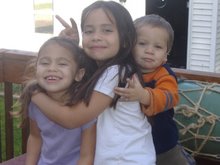
She really is adorable. Madelina and Armando have taken it upon themselves to be her playmates--riding their bikes around in the barnyard with her, jumping around and teaching her how to kick up her heals. It's pretty hilarious. And she is now my personal alarm clock, mooing loudly at the gate first thing in the morning, awaiting her breakfast. She gets going at around 5:30 a.m., not caring that I don't like to get up that early. Marcel just laughs and says, "Your newest daughter is calling you."
I'd rather he said, "Don't worry, sweetie. I'll feed her."
Oh well. She's doing well and is the one positive outcome from this situation, so I'm not going to complain. OK, so maybe I'll complain a little.
I wish I had happier news to share with you about the mother. If there's one lesson that farmers learn early and often: there isn't always a happy ending.
Sunday, July 18, 2010


Friday, July 9, 2010
Mama Cow.....
...has another calf?
A quick recap of yesterday's fiasco:
I'm stuck with the nagging thought that we failed this mama and the poor dead heifer calf. Did we think she could have twins in there? Actually, yes we did. Did we check for a twin after the first heifer was born. Actually, yes we did. But we only stuck our arm in up to the forearm. We should've stuck our arm in up to our shoulder.
The vet said the calf died about 5 minutes after the first one was born. We have learned a very costly lesson. Again.
A quick recap of yesterday's fiasco:
Marcel checked on the Mama.
I went to move the cows to a fresh paddock.
Marcel started whistling, yelling, waving.
I knew something was wrong.
Mama cow had a hoof coming out her rear.
Yes, I said a hoof.
The hoof was upside-down.
Marcel inserted his arm.
Yes, arm.
He couldn't find the other foot.
I inserted my arm.
I couldn't find the other foot.
I called the vet.
"The mother cow is having another calf."
"There is only one hoof presenting and it's breech."
"We can't find the other foot."
Vet said, "I'll find it."
Mother cow is lying head outstretched.
Mother cow is moaning.
Mother cow is breathing abnormally.
Vet arrives, gloves up, inserts arm.
Says, "This is going to be a disaster."
Vet pushes calf back in.
Vet works for about 10 minutes finding other hoof.
Vet pulls other hoof out.
He hooks it to the calf-puller: a pulley system used for emergencies.
I drive the tractor close to mama cow.
Marcel hooks pulley to tractor and starts cranking.
Marcel pulls dead calf out.
It was a girl.
Mama cow looks relieved.
Mama cow sits upright again.
Mama cow is all swollen on the inside.
I run home and get the antibiotics in my fridge.
Yes, there is a place for antibiotics and livestock.
This is it.
Marcel gave her 2 large injections, 50 ml total.
Mama cow drinks water and eats a little hay.
I'm stuck with the nagging thought that we failed this mama and the poor dead heifer calf. Did we think she could have twins in there? Actually, yes we did. Did we check for a twin after the first heifer was born. Actually, yes we did. But we only stuck our arm in up to the forearm. We should've stuck our arm in up to our shoulder.
The vet said the calf died about 5 minutes after the first one was born. We have learned a very costly lesson. Again.
This morning the mother cow is sitting upright again.
She is trying to stand.
She is one tough mama.
This afternoon we're going to try the hip lifter.
Basically it's a big clamp.
That you hook to her hip bones.
And lift her with the tractor.
To see if she can put weight on her back legs.
Thursday, July 8, 2010
When Physiological Becomes Psychological
The mother cow's physiological problem has played nicely into my own personal psychological problem. Namely, my fear of having to pull a calf on my own.
So when the mama cow went into labor yesterday, and little hooves were sticking out her rear by 1:00 pm, and the vet told me she wouldn't be able to birth lying down without assistance, and she was literally butted up to the barnyard fence with no way to move her and no room for the calf to come out.....the reality of the situation washed over me and put me into a minor tizzy. It was just me, standing there in the barnyard, swearing a little, realizing I was gonna have to do this by myself, alone. Well, my kids were there of course, you know, but I was basically alone. It was all me.
 (This picture was taken after the fact, but shows just how close the mama cow was to the fence.)
What'd I do? I called Marcel and told him he needed to come home from work NOW. Having some backup on the way relieved a bit of my anxiety (i.e., psychological problem). Then I got to work. I hooked the chains around the babe's legs and stretched open the vagina to see the calf's nose. Her tongue was hanging out and her nostrils were not moving--I needed to get the baby out right away.
Since I couldn't get behind the cow, I had to pull on the chains from the other side of the fence. I pulled, the mama pushed, and we got the calf's head out! The calf shook her head a little, she was alive, but now came the tricky part. How do we get her all the way out when there is no room for her? I was worried the mother would break her back when she moved.
So I called in reinforcements. No, not Farmer Scott. Not the vet. Not Marcel--he hadn't gotten there yet. I called my girls.
"Ana! Madelina! You've gotta help me, NOW!" I had them take over my position with the chains on the other side of the fence as I stretched open the mama cow's vagina. The girls pulled as hard as possible, saying things like, "EW! The chains are all goopy," and "This is really HARD," while I stretched the mother open, pulled on the calf's slippery shoulders, and rearranged the calf so she wouldn't get squished. The cow started to accept the help, gave a few good pushes, and the whole calf slipped out.
Thanks to the help of my girls, we got that calf safely out of her mother. 5 minutes later, Marcel arrived. Just in time to help us celebrate our small victory and get to work caring for the mother and babe.
The mother cow can't nurse the calf lying down, so the little heifer has become a bottle calf and has moved up to a stall in our barn. The mother is still down, but she's doing OK. She is eating and drinking water and hasn't given up yet, so we aren't giving up on her either. We fashioned a sort-of tent over her, using a large tarp and some round bale cages pushed up on their sides, to shade her from the hot sun. We're hoping that with the calf born, the pressure on her nerves will be relieved and she'll get up within a few days.
That's our hope: a double happy ending and the end of the mother cow's 'physiological problem'.
Here are some pictures, taken by my sister and Ana, after the calf was born. Enjoy.


So when the mama cow went into labor yesterday, and little hooves were sticking out her rear by 1:00 pm, and the vet told me she wouldn't be able to birth lying down without assistance, and she was literally butted up to the barnyard fence with no way to move her and no room for the calf to come out.....the reality of the situation washed over me and put me into a minor tizzy. It was just me, standing there in the barnyard, swearing a little, realizing I was gonna have to do this by myself, alone. Well, my kids were there of course, you know, but I was basically alone. It was all me.

What'd I do? I called Marcel and told him he needed to come home from work NOW. Having some backup on the way relieved a bit of my anxiety (i.e., psychological problem). Then I got to work. I hooked the chains around the babe's legs and stretched open the vagina to see the calf's nose. Her tongue was hanging out and her nostrils were not moving--I needed to get the baby out right away.
Since I couldn't get behind the cow, I had to pull on the chains from the other side of the fence. I pulled, the mama pushed, and we got the calf's head out! The calf shook her head a little, she was alive, but now came the tricky part. How do we get her all the way out when there is no room for her? I was worried the mother would break her back when she moved.
So I called in reinforcements. No, not Farmer Scott. Not the vet. Not Marcel--he hadn't gotten there yet. I called my girls.
"Ana! Madelina! You've gotta help me, NOW!" I had them take over my position with the chains on the other side of the fence as I stretched open the mama cow's vagina. The girls pulled as hard as possible, saying things like, "EW! The chains are all goopy," and "This is really HARD," while I stretched the mother open, pulled on the calf's slippery shoulders, and rearranged the calf so she wouldn't get squished. The cow started to accept the help, gave a few good pushes, and the whole calf slipped out.
Thanks to the help of my girls, we got that calf safely out of her mother. 5 minutes later, Marcel arrived. Just in time to help us celebrate our small victory and get to work caring for the mother and babe.
The mother cow can't nurse the calf lying down, so the little heifer has become a bottle calf and has moved up to a stall in our barn. The mother is still down, but she's doing OK. She is eating and drinking water and hasn't given up yet, so we aren't giving up on her either. We fashioned a sort-of tent over her, using a large tarp and some round bale cages pushed up on their sides, to shade her from the hot sun. We're hoping that with the calf born, the pressure on her nerves will be relieved and she'll get up within a few days.
That's our hope: a double happy ending and the end of the mother cow's 'physiological problem'.
Here are some pictures, taken by my sister and Ana, after the calf was born. Enjoy.

Water for the thirsty, tired mama.

Ana, attending the mother.

Madelina and Marcel, rubbing the calf to stimulate blood flow.

More massaging.

Isn't she darling? We're calling her Honey. Honeysuckle.

Ana, trying to feed Honeysuckle the colostrum replacement.

Making some shade for the mother.

The ending to my psychological problem? A successful calf-pull and darling little heifer named Honeysuckle.
Tuesday, July 6, 2010
Something Physiological
We are caring for an injured mama cow. We're not sure what happened, but she started limping about two weeks ago, taking care to not put any weight on her back left leg. We called the vet, thinking she had foot rot--a fungus that can cause painful sores on the hoof, but after giving her a thorough hoof cleaning, clipping and check-up he found nothing. "I'm worried it could be something physiological," he had said.
"Something physiological" sounds awfully vague and pretty scary to a beginning farmer like myself. So we locked her in the barnyard with some fresh hay and water which was effectively like sending her to bed for a little R & R.
Fast forward a few days and the poor thing can't get up anymore. She's lying upright and rocks back and forth as if she wants to stand, but then settles back down again, obviously frustrated with her inability to move. We called the vet out again to see if he could better diagnose the problem.
This time he said she must have a pinched nerve in the hip that is making her back leg useless. It could be that the almost full-term calf inside her could be pressing against a nerve. Or, it might be a "physiological injury" for which there may be no cure. He gave her a shot to get her labor started, with the hopes that we can assist her in giving birth, save the calf and hopefully relieve the pressure on her nerve.
Or, we might save the calf and have to put her down.
Or, we might lose them both.
In the meantime, I am visiting her every 1.5 hours, taking fresh cool water to her to drink, bathing her with a little water to cool her down (she's lying in the open sun), and bringing her hay to eat. It's the least we can do to keep her comfortable until her labor begins. Please wish us luck.
"Something physiological" sounds awfully vague and pretty scary to a beginning farmer like myself. So we locked her in the barnyard with some fresh hay and water which was effectively like sending her to bed for a little R & R.
Fast forward a few days and the poor thing can't get up anymore. She's lying upright and rocks back and forth as if she wants to stand, but then settles back down again, obviously frustrated with her inability to move. We called the vet out again to see if he could better diagnose the problem.
This time he said she must have a pinched nerve in the hip that is making her back leg useless. It could be that the almost full-term calf inside her could be pressing against a nerve. Or, it might be a "physiological injury" for which there may be no cure. He gave her a shot to get her labor started, with the hopes that we can assist her in giving birth, save the calf and hopefully relieve the pressure on her nerve.
Or, we might save the calf and have to put her down.
Or, we might lose them both.
In the meantime, I am visiting her every 1.5 hours, taking fresh cool water to her to drink, bathing her with a little water to cool her down (she's lying in the open sun), and bringing her hay to eat. It's the least we can do to keep her comfortable until her labor begins. Please wish us luck.
Wednesday, June 30, 2010
Left Behind
People have left many things behind when they come to buy eggs. They've left egg cartons and money in the envelope, of course, but also sippy cups, shopping receipts, toys, etc.
Today someone left behind their child.
P.S. We were home, child was playing with the chickens, all was well.
P.S.S. Can it get any crazier than that?
P.S.S.S. Don't answer that please. I don't wanna know.
Today someone left behind their child.
P.S. We were home, child was playing with the chickens, all was well.
P.S.S. Can it get any crazier than that?
P.S.S.S. Don't answer that please. I don't wanna know.
Sunday, June 27, 2010
Grassfed Beef for Sale
Currently Available: Grass-fed, grass-finished beef.
The meat will be available on or around July 14th and processing will be done at Eickman’s Processing in Seward, IL. (All wholes, halves and quarters will be picked up at Eickman’s.) Please place your order as soon as possible, keeping in mind that orders will be filled on a first come first served basis.
___Whole beef, $3.00/lb. hanging weight* (approx. 320-400 lbs. beef)
___½ beef, $3.25/lb. hanging weight* (approx. 160-200 lbs. beef)
___¼ beef, $3.50/lb. hanging weight* (approx. 80-100 lbs. beef)
___Variety Beef Box, $135
Our cattle are rotated through organically-managed pastures and have free-choice access to an organic salt, mineral and kelp supplement. They are fed absolutely no grain, hormones or antibiotics.
Send your name, contact information and order to Jackie at comepifa@aol.com. Thank you!
Local orders only. We do not ship or deliver at this time.
The meat will be available on or around July 14th and processing will be done at Eickman’s Processing in Seward, IL. (All wholes, halves and quarters will be picked up at Eickman’s.) Please place your order as soon as possible, keeping in mind that orders will be filled on a first come first served basis.
___Whole beef, $3.00/lb. hanging weight* (approx. 320-400 lbs. beef)
___½ beef, $3.25/lb. hanging weight* (approx. 160-200 lbs. beef)
___¼ beef, $3.50/lb. hanging weight* (approx. 80-100 lbs. beef)
*Processing fee not included. Processing usually runs about $0.55/lb. depending on how you specify your order. You will need to contact Eickman’s to specify which cuts you prefer.
Includes approx. 25 pounds of varied cuts: steaks, roasts, round steaks and/or cube steaks, ground beef, etc. Processing fee is included in this price. You will pick up box at the farm.
Our cattle are rotated through organically-managed pastures and have free-choice access to an organic salt, mineral and kelp supplement. They are fed absolutely no grain, hormones or antibiotics.
Send your name, contact information and order to Jackie at comepifa@aol.com. Thank you!
Local orders only. We do not ship or deliver at this time.
Thursday, June 24, 2010
Farm Events Galore
We've been busy this spring. Busy with farm work, yes. But also busy with events. Farm events.
The renewed interest in local food has meant that there are a lot of people suddenly interested in and wanting to visit farms. So far this spring we've been the destination for a local elementary school field trip, we participated in our second annual Openfields Farm Tour, and we hosted a Pasture Walk. All of these events are a lot of fun (and a lot of work).
The first event, the fieldtrip, brought 20 1st-graders and their parents out to see the chickens. Each classroom at their school focused on a different farm animal, organized a field trip around that animal, and then reported what they learned back to the others. They all visited a large farm and a small farm in the same day to see the differences in production styles, which I thought was a brilliant idea.
The kids that came here had first visited Phil's Fresh Eggs in Forreston. There they got to see a video about egg production, they got to see the egg washing machines, the egg sorters, the egg packing machines, etc. Everything is very mechanized--it has to be when you're packing 150,000 dozen eggs a day (!)--and must be pretty cool to watch, especially for a 1st grader! But they didn't get to go in a see the chickens (disease control) and they didn't get to touch an egg (not quite sure why--couldn't they spare a couple?).
When they got here, I let them visit the chickens, taught them about the different breeds and showed them the food that we used. We showed them the baby chicks and explained the difference between those used for meat production and those kept for eggs. They got to hold the chicks and gather some eggs. Every single one of them got to candle their own egg, grade it and put it in the appropriate-sized egg carton. They then took home a few dozen eggs (the teachers insisted on paying for them) so they could each take an egg home with them. I joked that I took no responsibility for school-bus-induced scrambled eggs in their backpacks.
The kids had fun, and so did I, but the best thing that came of that fieldtrip was the packet of thank you letters and hand-drawn pictures I got back from the kids about 2 weeks later. They were absolutely hilarious.
Next, we participated in the Openfields Farm Tour for the second year in a row. I seriously considered not doing it this year because the tour comes at the busiest time of year for us. But it's an Extension event, and I work for Extension, and my boss and co-worker basically told me I had no choice but to sign up for the tour, the big bullies.
That's OK, it turned out to be a lovely day, Laura and Rob and family came over to help, and we had about 90 people come by the farm. Wow!

Look at that farm crew! (Madelina was such a good tour guide she was given a few tips and I even had a lady threaten to steal her away. We definitely have her slated for the marketing and advertising department.)

Here are some happy visitors taking home a dozen eggs. (This lady is running for the county board! She likes farms, so she just might get my vote.)
 Rob is taking some visitors out to see the baby calves, which reminds me I need to post some pictures of them soon.

And Ana is taking advantage of the fact that we finally have enough people around to make a good go at a lemonade stand. Marketing and development for her, too.
All in all the day was a success.
Our final farm event was a Pasture Walk. A pasture walk is an informal event for people interested in grazing. It was hosted by the U of I Extension and the Northwest Illinois Grazing Network. Extension did a good job of advertising for the event so we had between 20 and 25 people come, which I think was a really great turnout.

I explained our operation, Jim Morrison from Extension provided some technical information about finishing animals on grass, forage values, grazing techniques, etc., and Ed Johnston from NRCS gave the crowd some information about the EQIP program, which we used to cost-share for our fences and waterlines. There was a nice article in the Freeport Journal Standard about it, so I'll let you read it.
That's right, I'm getting tired of typing. Follow this link:
Pasture Walk
The renewed interest in local food has meant that there are a lot of people suddenly interested in and wanting to visit farms. So far this spring we've been the destination for a local elementary school field trip, we participated in our second annual Openfields Farm Tour, and we hosted a Pasture Walk. All of these events are a lot of fun (and a lot of work).
The first event, the fieldtrip, brought 20 1st-graders and their parents out to see the chickens. Each classroom at their school focused on a different farm animal, organized a field trip around that animal, and then reported what they learned back to the others. They all visited a large farm and a small farm in the same day to see the differences in production styles, which I thought was a brilliant idea.
The kids that came here had first visited Phil's Fresh Eggs in Forreston. There they got to see a video about egg production, they got to see the egg washing machines, the egg sorters, the egg packing machines, etc. Everything is very mechanized--it has to be when you're packing 150,000 dozen eggs a day (!)--and must be pretty cool to watch, especially for a 1st grader! But they didn't get to go in a see the chickens (disease control) and they didn't get to touch an egg (not quite sure why--couldn't they spare a couple?).
When they got here, I let them visit the chickens, taught them about the different breeds and showed them the food that we used. We showed them the baby chicks and explained the difference between those used for meat production and those kept for eggs. They got to hold the chicks and gather some eggs. Every single one of them got to candle their own egg, grade it and put it in the appropriate-sized egg carton. They then took home a few dozen eggs (the teachers insisted on paying for them) so they could each take an egg home with them. I joked that I took no responsibility for school-bus-induced scrambled eggs in their backpacks.
The kids had fun, and so did I, but the best thing that came of that fieldtrip was the packet of thank you letters and hand-drawn pictures I got back from the kids about 2 weeks later. They were absolutely hilarious.
Next, we participated in the Openfields Farm Tour for the second year in a row. I seriously considered not doing it this year because the tour comes at the busiest time of year for us. But it's an Extension event, and I work for Extension, and my boss and co-worker basically told me I had no choice but to sign up for the tour, the big bullies.
That's OK, it turned out to be a lovely day, Laura and Rob and family came over to help, and we had about 90 people come by the farm. Wow!

Look at that farm crew! (Madelina was such a good tour guide she was given a few tips and I even had a lady threaten to steal her away. We definitely have her slated for the marketing and advertising department.)

Here are some happy visitors taking home a dozen eggs. (This lady is running for the county board! She likes farms, so she just might get my vote.)


And Ana is taking advantage of the fact that we finally have enough people around to make a good go at a lemonade stand. Marketing and development for her, too.
All in all the day was a success.
Our final farm event was a Pasture Walk. A pasture walk is an informal event for people interested in grazing. It was hosted by the U of I Extension and the Northwest Illinois Grazing Network. Extension did a good job of advertising for the event so we had between 20 and 25 people come, which I think was a really great turnout.

I explained our operation, Jim Morrison from Extension provided some technical information about finishing animals on grass, forage values, grazing techniques, etc., and Ed Johnston from NRCS gave the crowd some information about the EQIP program, which we used to cost-share for our fences and waterlines. There was a nice article in the Freeport Journal Standard about it, so I'll let you read it.
That's right, I'm getting tired of typing. Follow this link:
Pasture Walk
Subscribe to:
Posts (Atom)